

Chain abstraction routers are reshaping the multichain landscape, delivering unified user experiences across L2s and L3s through intents-based protocols. Yet, their full potential remains locked behind trust barriers in agent-to-agent interactions. ERC-8004 intents standard changes that equation. Introduced in August 2025, this Ethereum proposal equips multichain agents with on-chain identity, reputation, and validation mechanisms, paving the way for seamless cross-chain settlements and executions. As deployment nears on mainnet in early 2026, routers like those powering omnichain UX can finally orchestrate complex workflows without centralized intermediaries.
Picture autonomous agents negotiating deals across chains: one scouts liquidity on an L2, another routes intents via x402 intent service micropayments, all verified trustlessly. ERC-8004 makes this reality by standardizing agent economies within the EVM ecosystem. It supports deployment on Ethereum and L2s alike, using CAIP-10 for chain-agnostic identities. This alignment with account abstraction (ERC-4337) positions it as a cornerstone for frictionless DeFi and beyond.
ERC-8004's Three Registries: Identity, Reputation, Validation
The standard's power lies in its trio of on-chain registries, each engineered for precision in ERC-8004 intents. Agents register once and operate everywhere, slashing discovery friction that plagues current multichain setups.
Key ERC-8004 Registries
- 1. Identity Registry: Utilizes ERC-721 tokens for unique, portable agent IDs, ensuring verifiable, censorship-resistant identities across Ethereum and L2s. EIP-8004
- 2. Reputation Registry: Stores on-chain feedback signals from clients on agent performance, with off-chain aggregation for flexibility. EIP-8004
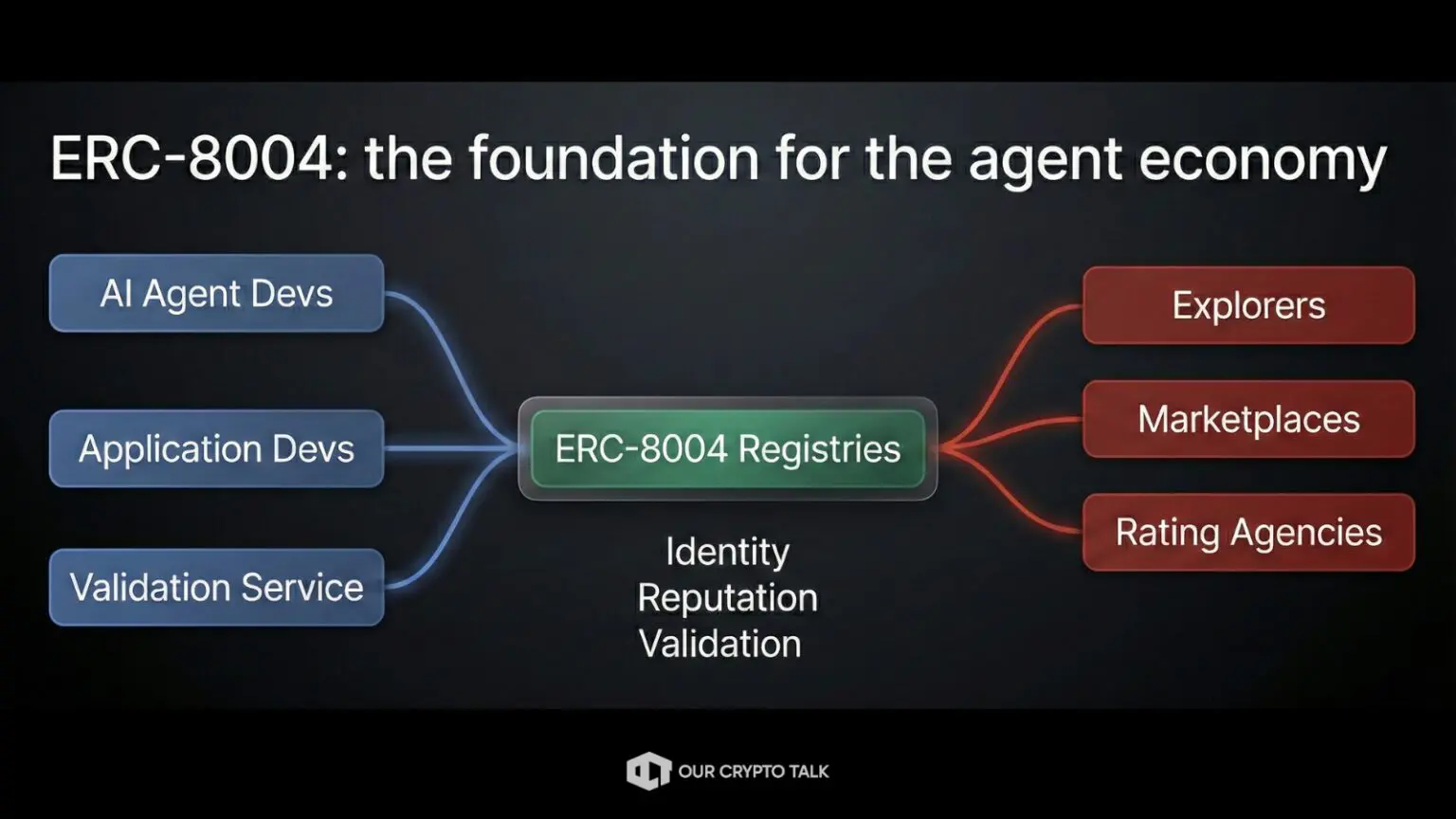
- 3. Validation Registry: Enables TEEs, zkML proofs, or stake mechanisms for cryptographic validation of task outcomes. EIP-8004
Identity Registry leads with ERC-721 tokens, assigning verifiable, censorship-resistant IDs linked to off-chain metadata on capabilities and protocols. Reputation Registry captures raw performance signals from clients, stored immutably while allowing flexible off-chain scoring. Validation Registry seals the deal, supporting mechanisms like stake-secured re-execution or zero-knowledge proofs to confirm task outcomes independently.
ERC-8004 gives AI agents on-chain identity, trust, and validation. Ethereum's trustless agent era begins January 2026.
This structure extends Google's A2A protocol trustlessly, as noted in early analyses. Agents maintain consistent identities across networks, critical for chain abstraction routers handling intents that span L3s.
Bridging Intents and Chain Abstraction via x402 Integration
Chain abstraction routers thrive on intents: user goals translated into cross-chain actions. ERC-8004 supercharges this by integrating with x402, enabling instant stablecoin micropayments over HTTP. Agents pay for services mid-flow, with proofs feeding back into reputation scores. No more stalled transactions waiting for off-chain trust; everything settles on-chain.
Consider a router fulfilling a swap intent: it discovers specialist agents via Identity Registry, checks reps, validates executions, and routes payments seamlessly. This isn't hype; community signals point to mainnet rollout as early as late January 2026, aligning with Ethereum's decentralized AI push. Risks exist, like endpoint impersonation, but mitigations via zkTLS or signed DNS proofs keep implementations robust.
Real-World Implications for Multichain Agent Economies
By Q1 2026, expect multichain agents to swarm routers, forming workflows that dwarf today's toys. OpenClaw demos already show agents negotiating deposits and generating transactions trustlessly. Ethereum's backing standardizes trust expression, letting agents trade services across L2s without human oversight. For developers building omnichain dApps, this means intents executed with cryptographic certainty, reputations compounding value over time.
These agent economies will redefine chain abstraction routers, turning them into hubs for intent fulfillment at scale. Routers query registries to match intents with vetted agents, execute via validation proofs, and settle with x402 micropayments, all in sub-second latencies across L2s. Early adopters like OpenClaw demonstrate this in action: an agent hunts for a car on one chain, negotiates across another, posts a deposit trustlessly, and finalizes via on-chain settlement. No human dealer, no custody risks, just code enforcing outcomes.
ERC-8004 Risks & Mitigations for Chain Abstraction Routers
| Risk | Description | Mitigation | Registry Comparison | Benefits |
|---|---|---|---|---|
| Endpoint/Domain Impersonation ⚠️ | No direct ownership verification, spoofing tricks routers | zkTLS proofs 🔒, Signed DNS records, Reputation Registry filtering, Multi-registry checks before dispatching intents ✅ | Identity (ERC-721 IDs, metadata links), Reputation (on-chain signals, off-chain scores), Validation (TEEs/zkML/stake proofs) | Reduced discovery time ⚡, Trustless execution 🔐, Micropayment integration 💰 |
Validation mechanisms shine here. Stake-secured re-execution lets routers challenge suspect outcomes, slashing collateral from liars. TEEs provide hardware-enforced privacy for sensitive computations, while zkML verifies AI decisions without revealing models. For L3-heavy routers, this stack ensures intents cascade reliably, even amid network congestion.
ERC-8004 becomes a focal point in Ethereum's emerging decentralized AI strategy, aligning with both account abstraction (4337).
Pair this with ERC-4337's account abstraction, and multichain agents gain programmable wallets that auto-fund via intents. A router could spin up ephemeral agents for one-off tasks, paying them fractions of a cent through x402 over HTTP, then dissolve them post-validation. This frictionless loop crushes legacy silos, where users juggle wallets per chain.
Developer Playbook: Integrating ERC-8004 into Routers
Builders targeting omnichain UX start simple. Deploy your router's agent to the Identity Registry with an ERC-721 token, embedding capabilities like 'L2 liquidity scouting' or 'intent bundling. ' Off-chain metadata points to API endpoints and supported chains via CAIP-10. When fulfilling user intents, query Reputation for top performers, dispatch tasks, and poll Validation for proofs. x402 integration hooks payments into HTTP headers, automating economics without smart contract bloat.
Testnets already buzz with this. As mainnet eyes late January 2026 rollout, Ethereum Foundation signals full EVM compatibility, letting L2 routers like those on Optimism or Arbitrum plug in natively. Opinion: this isn't incremental; it's the protocol layer agents have begged for since A2A hype. Without it, chain abstraction stays user-facing only. With ERC-8004, routers evolve into agent orchestrators, compounding network effects as reputations accrue.
Zoom out to 2026 horizons: trustless agents fueling DeFi composability, where a single intent swaps across 10 L3s, negotiated by specialists with proven reps. Routers become the UX glue, abstracting not just chains but entire agent meshes. Early movers win big, as first-mover reputations lock in premium flows. Ethereum's machine economy awakens, one verified intent at a time.
Stake your claim now. With ERC-8004 live soon, the multichain world shifts from fragmented experiments to orchestrated precision.




No comments yet. Be the first to share your thoughts!